
Horizontal integration, defined as software that is NOT dependent on another software to run or use, making the integration “optional.”
Vertical integration, defined as software that is dependent on another software to run or use. Providing deep integral usage and software management.
Asset Intensive customers rely heavily on the Enterprise Asset Management (EAM) for their business operating system. The EAM allows the operator to define and track CAPEX (Capital Expenditures) and OPEX (Operational Expenditures), manager customers, suppliers, employees, perform accounting, and report the financial health and safety of the organization to stakeholders.
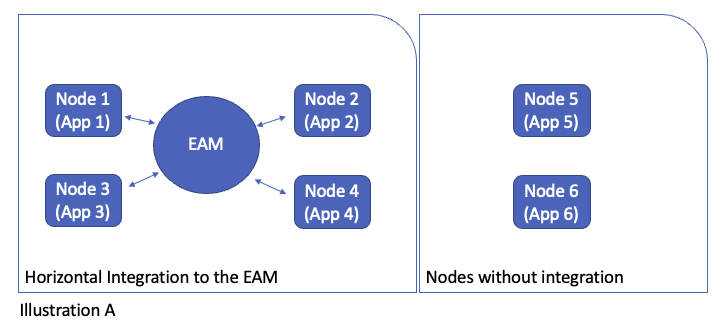
Shown in the Illustration A where “nodes” are displayed as third party software apps to the primary EAM.
In this scenario, it is easy to see why this becomes unsustainable over a period of time. IT and software vendors may achieve initial integration, but changes to the EAM, or nodes, overtime will cause the integrations to not achieve the objective, or fail all together. Below are problematic areas with horizontal integration, but note the list is not exhaustive.
1. Major platform changes to the Operating System, Middleware, EAM platform or nodal apps.
2. 3rd party software vendors mid and long term roadmap and viability
3. Data Synchronization
4. Data Duplication
5. Data Silos
6. Security vulnerabilities
Vertical integration ensures there are no nodes to manage, but apps that exist within a common software solution “stack.”
The software “stack”, is defined as the platform that provides a data layer, business logic layer, end user application layer, as well as functions such as user and security management, application development, internationalization and localization, and package and deployment capabilities.
Most EAM’s offer this capability, but third party software vendors have stayed away from vertical integration because it constrains them to the specific EAM vendor, though there is large overlap in functionality. However, customers who rely on the EAM desire vertical integration because they understand well the issues of Horizonal Integration.
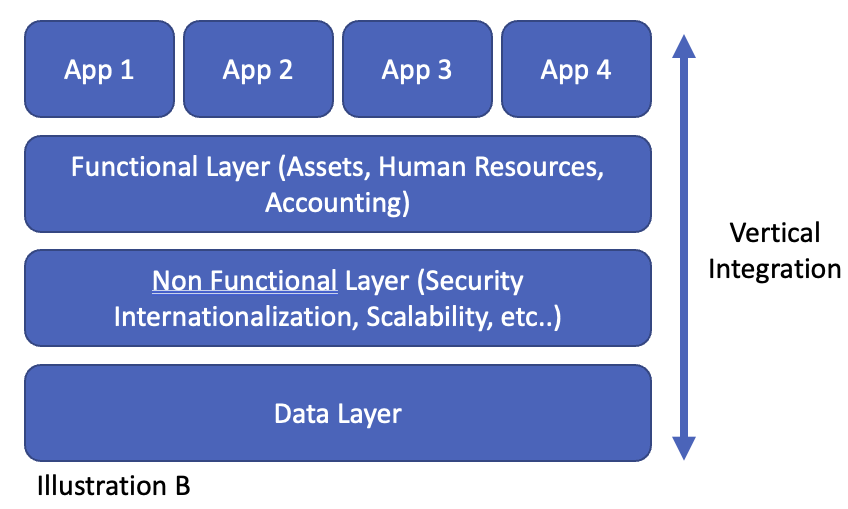
As shown in the Illustration B. Note, there are no “nodes” to maintain, but a scalable and maintainable platform. Allowing asset intensive businesses to manage a common data model to develop applications from, while allowing IT departments to scale to meet global changes to the business within a secure infrastructure.
Asset Intensive business struggle with defining data models and software functionality that helps them scale the business while meeting production, health, safety, and environmental objectives.Cloud based platforms such as the SAP BTP (Business Technology Platform) allows the business to create and manage core data sets and functionality, while allowing “apps” to be developed and deployed within the “stack” to help meet tactical and strategic business initiatives.